11
Most people only think about leg workouts when they are chasing sore quads or trying to keep up with a gym routine. Yet the real value of lower-body training shows up outside the gym. It is there when you climb a flight of stairs carrying groceries, catch yourself on an uneven sidewalk, or get up off the floor without using your hands.
Building resilient legs does not require heavy barbells, complicated machines, or hour-long sessions. A handful of straightforward bodyweight movements, done with control and consistency, can steadily improve strength, stability, and mobility at the same time. When those three qualities develop together, your joints feel better, your balance sharpens, and everyday movement takes noticeably less effort.
Why Strength, Stability, and Mobility Belong Together
Fitness advice often treats these three traits as separate goals, as if you need one workout for muscle, another for balance, and a third for stretching. In reality, your lower body functions as a connected system, and neglecting one piece usually limits the others.
Strength gives your muscles the capacity to produce force, whether you are standing up from a low chair or hiking uphill. Mobility is your ability to move a joint actively through its full, comfortable range of motion—not just stretching passively, but controlling the movement at the edges of that range. Stability is what keeps your knees, hips, and ankles aligned while you move, preventing wobbling and unnecessary joint strain.
Strong legs with stiff hips and tight ankles often force the lower back to pick up the slack. Flexible hips without enough strength to control them can leave knees feeling shaky under load. Choosing simple, multi-joint leg exercises bridges that gap naturally, training your muscles to produce force while guiding your joints cleanly through space.
Six Simple Leg Exercises Worth Building Into Your Week
You do not need a long list of exercises to see meaningful results. The six movements below cover pushing, hinging, single-leg control, and side-to-side motion. All you need is a little floor space and, for one movement, a sturdy step or low bench.
Bodyweight Squats
The squat is one of the most practical human movement patterns, and doing it well builds quad and glute strength while opening up the hips and ankles.
Stand with your feet roughly shoulder-width apart and your toes pointed slightly outward. Keep your chest tall, brace your midsection lightly, and sit your hips back and down as if lowering yourself onto a low chair. Aim to keep your heels planted flat on the floor and your knees tracking in line with your toes rather than collapsing inward. Pause briefly at the bottom where your form still feels solid, then press through the middle of your feet to stand back up.
If your heels lift or your lower back rounds early, start by squatting to a sturdy chair or bench. Touching the seat lightly before standing back up teaches proper depth and control without forcing your joints past what they are ready for.
Glute Bridges
Hours spent sitting at a desk or in a car tend to leave the front of the hips tight and the glutes underactive. Glute bridges reverse that pattern by strengthening the posterior chain—your glutes and hamstrings—while gently encouraging full hip extension.
Lie on your back with your knees bent, feet flat on the floor about hip-width apart, and arms resting at your sides. Drive through your heels to lift your hips until your body forms a straight line from your shoulders to your knees. Focus on squeezing your glutes at the top instead of overarching your lower back. Hold for a full second, then lower slowly with control.
Once two-legged bridges feel easy, lift one foot a few inches off the floor and perform the movement on a single leg. That simple shift immediately turns a basic strength drill into a serious hip-stability challenge.
Reverse Lunges
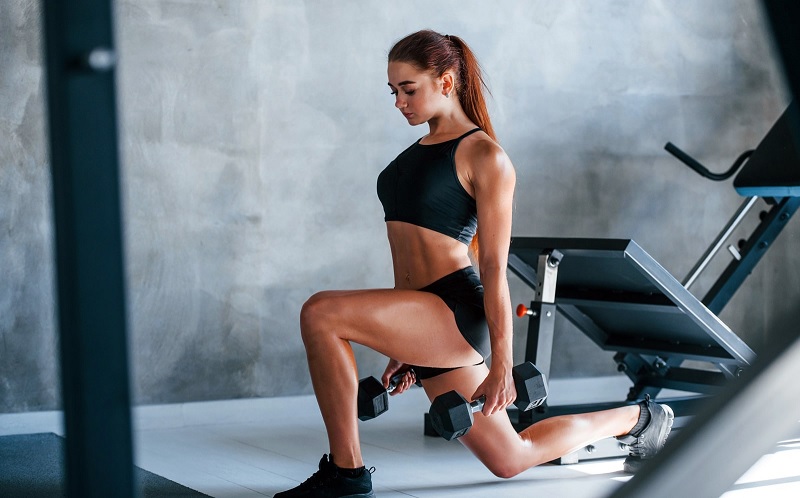
Forward lunges can sometimes irritate sensitive knees, especially if momentum pushes the front knee too far forward before the muscles catch it. Stepping backward instead makes it much easier to stay balanced and load the hips properly.
Start standing tall with your feet hip-width apart. Take a controlled step backward with your right foot, lowering your back knee toward the floor while keeping your front shin relatively vertical. Your torso can lean slightly forward from the hips, which helps engage the glutes. Push firmly through your front heel to return to the starting position, then switch sides.
Because reverse lunges require you to stabilize on one leg at a time, they quickly expose and correct side-to-side strength imbalances. They also give the hip flexor on your back leg an active stretch on every repetition.
Controlled Step-Ups
Walking up stairs is a daily reality, yet few people train the movement deliberately. Step-ups build single-leg power while teaching your knee and ankle to stay steady as your body weight shifts upward and downward.
Face a sturdy step, low box, or bottom stair. Place your entire left foot flat on the surface, lean slightly forward over that foot, and press up until you are standing tall on the step. Avoid pushing off aggressively with your trailing foot; let the elevated leg do the real work. The most valuable part comes next: lower your trailing foot back to the floor as slowly as you can.
Controlling that downward phase builds eccentric strength, which is what protects your knees when walking downhill, descending stairs, or decelerating during sports.
Lateral Lunges
Most daily workouts move strictly forward and backward, leaving the muscles that stabilize your hips from side to side relatively weak. Lateral lunges train the frontal plane, improving inner-thigh mobility and outer-hip stability in one motion.
Stand with your feet together and take a wide step out to your right. Shift your hips back and bend your right knee while keeping your left leg straight and both feet pointed mostly forward. You should feel a solid stretch along your straight inner thigh and steady work in your bent hip and quad. Drive through your right foot to push yourself back to the center, then repeat on the opposite side.
Start with a modest step width and shallow depth. As your hips loosen up over a few weeks, you can sink slightly deeper without letting your chest collapse toward the floor.
Standing Calf Raises
Calves rarely get much attention until an ankle rolls or foot pain shows up. Strong, mobile ankles act as the foundation for everything above them, directly influencing your stride, squat depth, and balance.
Stand near a wall or sturdy countertop for light fingertip support if needed. Rise smoothly onto the balls of your feet as high as you can, keeping your weight balanced across the base of your big toe and second toe rather than rolling onto the outer edges of your feet. Pause at the top for two seconds, then lower your heels slowly to the floor.
To add a mobility benefit, perform them with the balls of your feet on the edge of a step so your heels can drop gently below level before pressing back up.
How to Put These Exercises Into a Practical Routine
Consistency beats intensity every time, especially when your goal is healthier joints and sustainable strength. Aim to perform this circuit two to three times per week, leaving at least one rest day between sessions so your muscles can recover and adapt.
Before starting, spend two or three minutes warming up with brisk marching in place, gentle leg swings, or a few slow ankle circles. Then work through the six exercises in order:
-
Bodyweight Squats: 2 to 3 sets of 10 to 12 reps
-
Glute Bridges: 2 to 3 sets of 12 to 15 reps
-
Reverse Lunges: 2 to 3 sets of 8 to 10 reps per leg
-
Controlled Step-Ups: 2 to 3 sets of 8 to 10 reps per leg
-
Lateral Lunges: 2 to 3 sets of 8 reps per side
-
Standing Calf Raises: 2 to 3 sets of 12 to 15 reps
Rest for 45 to 60 seconds between sets, or move from one exercise to the next as a relaxed circuit if you are short on time. The entire routine takes roughly 20 minutes, making it realistic to fit into a lunch break or morning schedule.
Smart Ways to Progress Without Buying Equipment
Bodyweight training does not stop working once the basic movements feel manageable. You can keep challenging your legs for months simply by adjusting how you perform each rep.
Slow down the lowering phase. Taking three full seconds to lower into a squat, lunge, or step-up removes momentum and forces your stabilizing muscles to work much harder.
Add a brief pause. Holding the bottom of a squat or the top of a glute bridge for two seconds eliminates bounce and builds control right where your joints are most vulnerable.
Shift toward single-leg work. Moving from two-legged bridges and calf raises to single-leg versions roughly doubles the load on the working side while demanding far more balance from your hips and core.
Common Mistakes That Stall Lower-Body Progress
Even simple exercises lose their effectiveness when rushed. Moving too fast turns strength work into sloppy cardio, letting momentum carry you past the ranges of motion where mobility and stability actually improve. If you cannot pause cleanly at any point in a rep, slow down.
Another frequent snag is ignoring mild discomfort until it becomes a real setback. Normal muscle fatigue feels like a dull, even burn in the meat of the thighs, glutes, or calves. Sharp, pinching, or clicking pain inside a knee or hip joint is a signal to shorten your range of motion, adjust your foot stance, or step back to an easier variation.
Finally, resist the urge to skip single-leg exercises because they feel awkward at first. That slight wobble during a reverse lunge or step-up is not a sign that you should avoid the movement—it is the exact stimulus your nervous system needs to build better balance.
Building Legs That Support You for the Long Haul
Strong, stable, mobile legs are not reserved for competitive athletes. They are built quietly through simple movements practiced well and repeated over time. By focusing on controlled squats, bridges, lunges, step-ups, and calf raises a couple of times a week, you give your lower body the strength to handle daily demands and the joint control to stay comfortable doing it. Start where your body is today, prioritize clean form over speed, and let steady consistency do the heavy lifting.